The Unfinished

The Unfinished

Lately it seems like I’ve been abandoning books at a higher rate. It’s hard to tell exactly as marking a book “unfinished” on Goodreads clears out the date started, and I got out of the habit of resetting it. But it’s at least 5 since the beginning of the year, plus I have a 6th in a time out (and honestly, books rarely come out of time out).

Abandoning a book is a part of being a reader, whether you’re someone who reads a book or more a week, or someone who’s lucky to finish a couple in a year. Either way, your reading time is precious and you shouldn’t spend it on books you’re not into. I always think of the third law of library science, “Every book its reader.” Every book is for someone, but no book is for everyone. You’re bound to encounter books that aren’t for you. This can mean a lot of different things:

  • Sometimes the story is too complex and you Cannot Even, no matter how much you want to: Nona the Ninth
  • Other times you just bounce right off: Witches
  • Maybe you’re sick, or it’s allergy season: The Employees
  • Or some quirk of the writing jumps out at you, and maybe you just can’t unsee it: Point Roberts

There are also circumstantial reasons that you might not finish a book:

So why do we sometimes feel like we should finish a book we’re not enjoying?

There are also aspirational reads:

Just stop! Don’t get too wrapped up in reading at least a certain amount before abandoning something: Infinite Jest (20% of this one is itself a short novel! Spare yourself the attempt and read one of these instead.)

If you’re not ready to commit to abandoning it, put it in a time out. I’ve paused books I wasn’t enjoying to see what my book club thought, and then decided whether to finish based on the discussion. I’ve also paused books to see if I feel compelled to pick them back up after I read something else.

As you abandon and pause books, try to form a sense of why, as it’ll help you avoid books you’re unlikely to be into. It could be something stylistic, or it could be situational. Understanding that can also help you figure out if it’s something to come back to in the future.

You can of course decide to plow through anyway, skimming your way through the remainder. But before you do that with an ebook, check the page count first. It could be 800+ pages: To Sleep in a Sea of Stars

What I read on my January vacation

What I read on my January vacation

I recently came back from a longish vacation to sunnier climes. Why we returned from here is unclear to me:

Sunrise over a white sand beach. The sky is still mostly light grey, with streaks of yellow and orange just above the water. The view is framed by a few fronts form a palm tree at left, and the edge of a thatch-roofed platform at right.
Sunrise in Cancun.

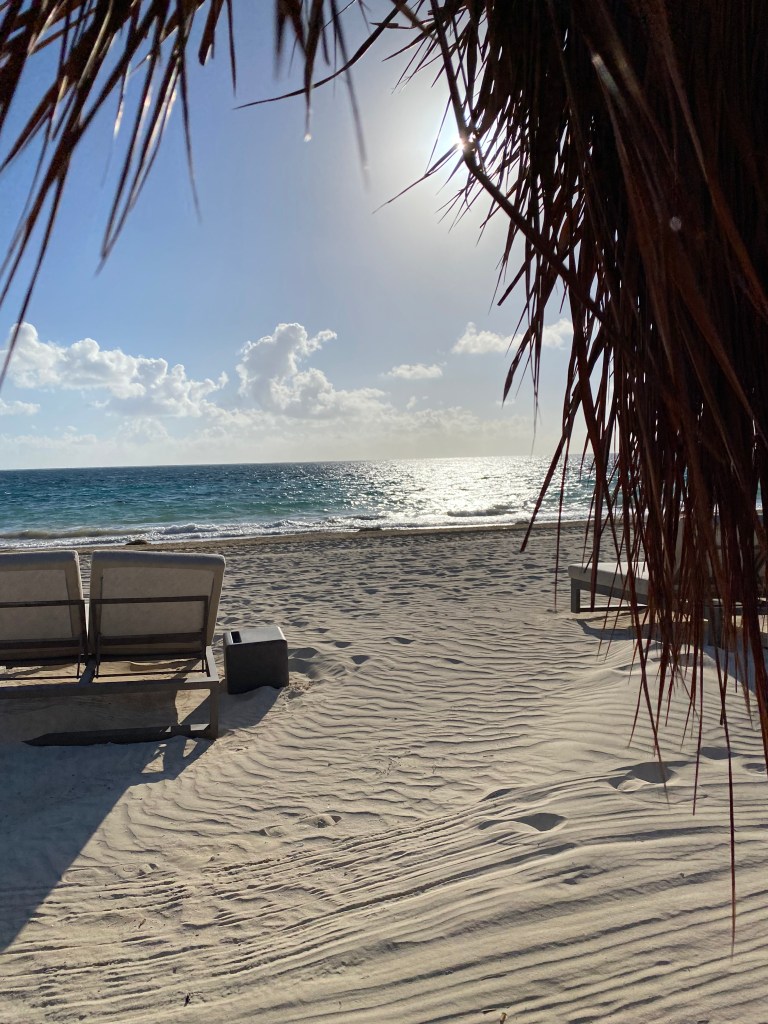
We spent a lot of time lounging by the beach or the pool, as you do when this is the view:

A view of the water taken from under a thatched umbrella. The Sky is a light blue, with the sun just hidden by some pieces of straw hanging down from the umbrella. The water is turquoise blue and set off by some fluffy clouds in the distance.
Midday at the beach.

Anyway. I read three entire books, finished one, and started another. None of them would be categorized as a “beach read,” but in my opinion if you read something at the beach, it’s a beach read.

All the Murmuring Bones, A.G. Slatter: The mood and the world-building were great — there are some wonderful mythical creatures in this one. I did feel the ending was a little rushed, but it was also plausible.

The Department of Rare Books and Special Collections, Eva Jurczyk: I didn’t like this as much as I’d hoped. There are a lot of academic politics and a protagonist who is sort of just letting herself be buffeted along for much of the story. She finally starts to get interesting at the end.

Bleeding Heart Yard, Elly Griffiths: I never really try to solve the mystery, but sometimes you start to develop a theory, and mine was completely wrong this time, in a good way. This is the third installment in the Harbinder Kaur series. You can certainly read this as a standalone, but you’ll get a little more out of it if you read the other two first.

The Starless Sea, Erin Morgenstern: Somehow this hadn’t been on my radar until recently, but it was such a lovely read. It was so immersive and I was sad to leave the story and the characters when I finished. I saw a few beats of the plot coming, but that didn’t get in the way of my enjoyment.

The Age of Vice, Deepti Kapoor: This is the first pick in Roxane Gay’s book club this year, and it was incredible. Very layered and I liked how you see some of the same events through different perspectives. This is set in Delhi and the city is very much a character as well.

2022 Best Books of the Year by Vibes

2022 Best Books of the Year by Vibes

We interrupt your somewhat regularly scheduled cooking programming with a post about things you should read.

This year I read a lot of really good books. Some I rated 5 stars, some I rated 4. Since the star rating really just represents a hot take after I finish the book, it doesn’t necessarily reflect books that stuck with me. So that brings us to this list.

First of all, the best book I read this year was The Woman in the Library by Sulari Gentill. It’s so good and the slow burn of creepiness was perfection. If you are a mystery fan you should absolutely pick this up.

Light From Uncommon Stars, by Ryka Aoki: The description for this will make you wonder how it could possibly work, but it does and it’s so lovely.

Vespertine, by Margaret Rogerson: If you’re pretty sure you’d like The Locked Tomb series if you had any idea WTF was going on, you’ll probably like this and you’ll definitely be able to follow it.

The Rose Code, Kate Quinn: A WWII novel about female codebreakers. Full of wonderful storytelling and characters.

Shit Cassandra Saw, Gwen E. Kirby: A playful and hilarious collection of stories. My favorite was Midwestern Girl Is Tired Of Appearing In Your Short Stories, but A Few Normal Things That Happen A Lot was a close second.

A History of Wild Places, Shea Earnshaw: This caught my attention and kept it. Some may think the twist is obvious, but I figured it out shortly before the characters did which made for a very satisfying reading experience.

Matrix, Lauren Groff: You may think you don’t want to read about a 12th century nun, but you’re wrong.

Great Circle, by Maggie Shipstead: This is long but very worth it. My book club really enjoyed this.

Sea of Tranquility, Emily St. John Mandel: This book is a whole mood.

The Paradox Hotel, Rob Hart: People vacation via time travel and have to stay at a giant hotel the night before. What could possibly go wrong?

Strange Practice, Vivian Shaw: Vampires need health care, too. As do mummies and assorted other supernatural beings.

The Women Could Fly, Megan Giddings: What if the witch trials happened today? (shudders)

If for some reason you want to see everything I read this year, here you go.

Summer Reading

Summer Reading

Do you miss the days of choosing five books off of a long list to read over the summer? Is your to-be-read list where your best reading intentions to go die? Do you like it when opinionated people make decisions for you? This one’s for you.

The Lost Man, by Jane Harper: Assuming you’ve read Tana French (and if you haven’t, you start with either The Witch Elm or In the Woods), this is your next move, and it takes you to an Australian ranching community.

Every Anxious Wave, by Mo Daviau: This crosses High Fidelity with time travel. What else do you need to know?

The Library Book, by Susan Orlean: An absolutely wonderful book about the LA Public Library, and a huge fire there in the 80s.

The Luminous Dead, by Caitlin Starling: My book club loved this. We read it in 2019 and I still think about it. It’s full of atomospheric creepiness and is really well paced.

The Spellman Files, by Lisa Lutz: The first in a very fun series about a family of private detectives. Yes, they’re as dysfunctional as you think.

Hench, by Natalie Zina Walschots: So, you know how supervillians are surrounded by hench people? Well, what if one of them got really mad at a particular superhero and channeled her rage into big data?

The Water Knife, by Paolo Bacigalupi: If you read Gold Fame Citrus and have been wondering if there’s any other speculative fiction out there about the droughts in the Western US, there is. Read this.

Wanderers, Chuck Wendig: If you liked The Stand, and you’re ready for a novel about a respiratory pandemic, try this. (If it’s too long for you, pick up Severance by Ling Ma.)

Lastly, two wildcards:

A Marvellous Light, Freya Marske: The July book club book.

Something New Under the Sun, Alexandra Kleeman: The most recent book I started but am not going to finish. I got too irritated by a couple of the characters who feature prominently in the first chapter.

A Psalm for the Wild-Built

A Psalm for the Wild-Built

Once a month I recommend a novel that I’ve recently read and enjoyed. This time it’s the charming start to a new series by one of my favorite writers.

A Psalm for the Wild-Built by Becky Chambers

Tom Doherty Associates,
Libraries | Bookshop | Goodreads

Becky Chambers wrote one of my most beloved series, Wayfarers. So of course I came to this, the first book of her new series, with high hopes. I was so happy with what I found. 

The driving conflict in the book occurs well before the timeline that we’re in, when robots become sentient and humans decided that they weren’t going to try and force them into submission and continued labor. The earth is divided between human and robot territory, and the robots retreat into the wilderness. Centuries later, humans have survived and rebuilt civilization into something that looks much like before technology.

That’s something I’m doing. That’s not my reason for being. When I am done with this, I will do other things.

The story follows Dex, who is in search of something more in life and changes their vocation from that of Garden Monk to Tea Monk. As a Tea Monk they travel from place to place, offering comfort and conversation to people, essentially a type of counseling. They enjoy it, but it still isn’t quite enough.

This book is lovely. It’s calm and quiet, philosophical but not in an abstract way. At least one review found some aspects of the worldbuilding a little difficult to believe, but I didn’t find them distracting.

This is a short review because this is a short book, more of a novella, really. If you’re not sure this is for you, I’d encourage you to pick it up anyway. It won’t take you long to read, and you’ll likely enjoy being transported into the world Chambers has built.